Showing posts with label Badminton. Show all posts

Singles Badminton Strategies

Many badminton players believe that only exceptional skills are required to win in badminton.  They fail to realize that not only skills are necessary, but also strategy.  A decent player with exceptional strategy can beat an exceptionally skilled player any day.  In this article I will give some basic strategies used in Singles Badminton.  Remember to have a game plan when playing badminton and then you can outwit your opponent.  Many players try to score a winning shot...EVERYTIME...rather than play a game winning strategy.

Singles Badminton Strategies


The strategy you utilize will depend upon the person you are playing.  If you have an opponent who is  great at smashing even from the baseline, then a long high serve to the opponent's back court may not be the best method to serve.  If you are playing a weaker skilled player, than a long, high serve can open up your opponents forecourt.  Mix things up always.  A disguised low serve after a long line of high serves can throw your opponent off and can even win you a point if disguised enough.

Guidelines for Singles Badminton


  • Try to make your opponent move about the court by hitting the shuttlecock away from your opponent.  
  • Observe!  Always observe.  Observe your opponent.  See his/her pattern of play.  See his weakness.  This is essential.
  • Be flexible.  If your favorite, most powerful shot is not working, do something else.  Again, find your opponents weakness.
  • If you are pressed, hit a defensive high shot that will give you time to regain your footing. 
The most important part of badminton is your position.  Always get back to your base position.  This is in the mid court area.  After every shot return to this position.

Badminton Muscles - Left and Right Side

In badminton, as in other racket sports, one side of the body is often used more than the other side.  If you are a left-handed player, then your left side is often more developed, and likewise, if you're right-handed, then your right side is often more developed.

badminton muscles


This can especially be seen with pros.  Even amateur players recognize their badminton muscles though.  Generally, the form arm, the bicep and tricep, as well as the shoulders and back of one arm are more developed and larger than the other side.  This can be awkward if you are to go swimming.  However, your pecs (mostly), abdomen, and the remainder of your torso is essentially the same on both sides.

Additionally, your legs shouldn't have much change in development or size.

It is not too difficult to counteract this onesideness.  You can either go to the gym and workout your other side consistently or start playing badminton with your opposite hand.  Both methods will soon even out your body so that you look normal.  The End.

Badminton Terminology

An essential part of playing Badminton is understanding the Badminton terminology that is associated with the game.  Below is a list of badminton terminology that you might encounter while playing the game.

badminton terminology


Badminton Terminology

  • Alley - extension of the court by 1-1/2 feet on both sides for doubles play.
  • Back Alley- Area between the back boundary line and the long service line for doubles.
  • Backcourt- Back third of the court, in the area of the back boundary lines.
  • Balk (Feint)- Any deceptive movement that disconcerts an opponent before or during the service.
  • Baseline- Back boundary line at each end of the court, parallel to the net.
  • Carry- An illegal tactic, also called a sling or a throw, in which the shuttle is caught and held on the racquet and then slung during the execution of a stroke.
  • Center or Base Position- Location in the center of the court to which a singles player tries to return after each shot.
  • Center Line- Line perpendicular to the net that separates the left and right service courts.
  • Clear- A shot hit deep to the opponents back boundary line. The high clear is a defensive shot, while the flatter attacking clear is used offensively.
  • Court- Area of play, as defined by the outer boundary lines.
  • Drive- A fast and low shot that makes a horizontal flight over the net.
  • Drop- A shot hit softly and with finesse to fall rapidly and close to the net on the opponent's side.
  • Fault- A violation of the playing rules, either in serving, receiving, or during play.
  • Feint (Balk)- Any deceptive movement that disconcerts an opponent before or during the service.
  • Flick- A quick wrist and forearm rotation that surprises an opponent by changing an apparently soft shot into a faster passing one; used primarily on the serve and at the net.
  • Forecourt- Front third of the court, between the net and the short service line.
  • Hairpin Net Shot- Shot made from below and very close to the net with the shuttle rising, just clearing the net, and then dropping sharply down the other side. The shuttle's flight approximates the shape of a hairpin.
  • Halfcourt Shot- A shot hit low and to midcourt, used effectively in doubles against the up-and-back formation.
  • Kill- fast downward shot that cannot be returned; a "putaway".
  • Let- A legitimate cessation of play to allow a rally to be replayed.
  • Long Service Line- In singles, the back boundary line. In doubles a line 2-1/2 feet inside the back boundary line. The serve may not go past this line.
  • Match- A series of games to determine a winner.
  • Midcourt- The middle third of the court, halfway between the net and the back boundary line.
  • Net Shot- Shot hit from the forecourt that just clears the net and then falls rapidly.
  • Push Shot- Gentle shot played by pushing the shuttle with little wrist motion, usually from the net or midcourt to the opponent's midcourt.
  • Racquet (Racket)- Instrument used by the player to hit the shuttlecock. Weight about 90 grams (3 oz). Length 680 mm (27 in). Made from metal alloys (steel/aluminum) or from ceramic, graphite or boron composites. Generally strung with synthetic strings or natural gut.
  • Rally- Exchange of shots while the shuttle is in play.
  • Serve (Service)- Stroke used to put the shuttlecock into play at the start of a rally.
  • Service Court- Area into which the serve must be delivered. Different for singles and doubles play.
  • Short Service Line- The line 6-1/2 feet from the net which a serve must reach to be legal.
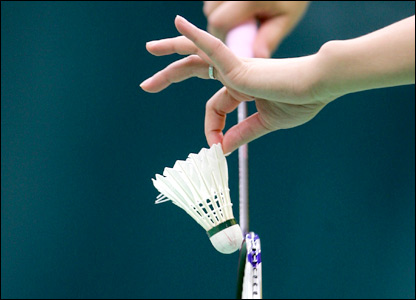
  • Shuttlecock (Shuttle)- Official name for the object that the players must hit. Composed of 16 goose feathers attached to a cork base covered with leather. Synthetic shuttles are also used by some.
  • Smash- Hard-hit overhead shot that forces the shuttle sharply downward. Badminton's primary attacking stroke.
  • Wood Shot- Shot that results when the base of the shuttle is hit by the frame of the racket. Once illegal, this shot was ruled acceptable by the International Badminton Federation in 1963.
Once you know the basic terminology used in badminton, you will be able to better communicate with either your opponent or your ally while you play the game.